






Marginal Gains in Professional Cycling: Why Team Visma Trusts HISTRIPS for Peak Performance
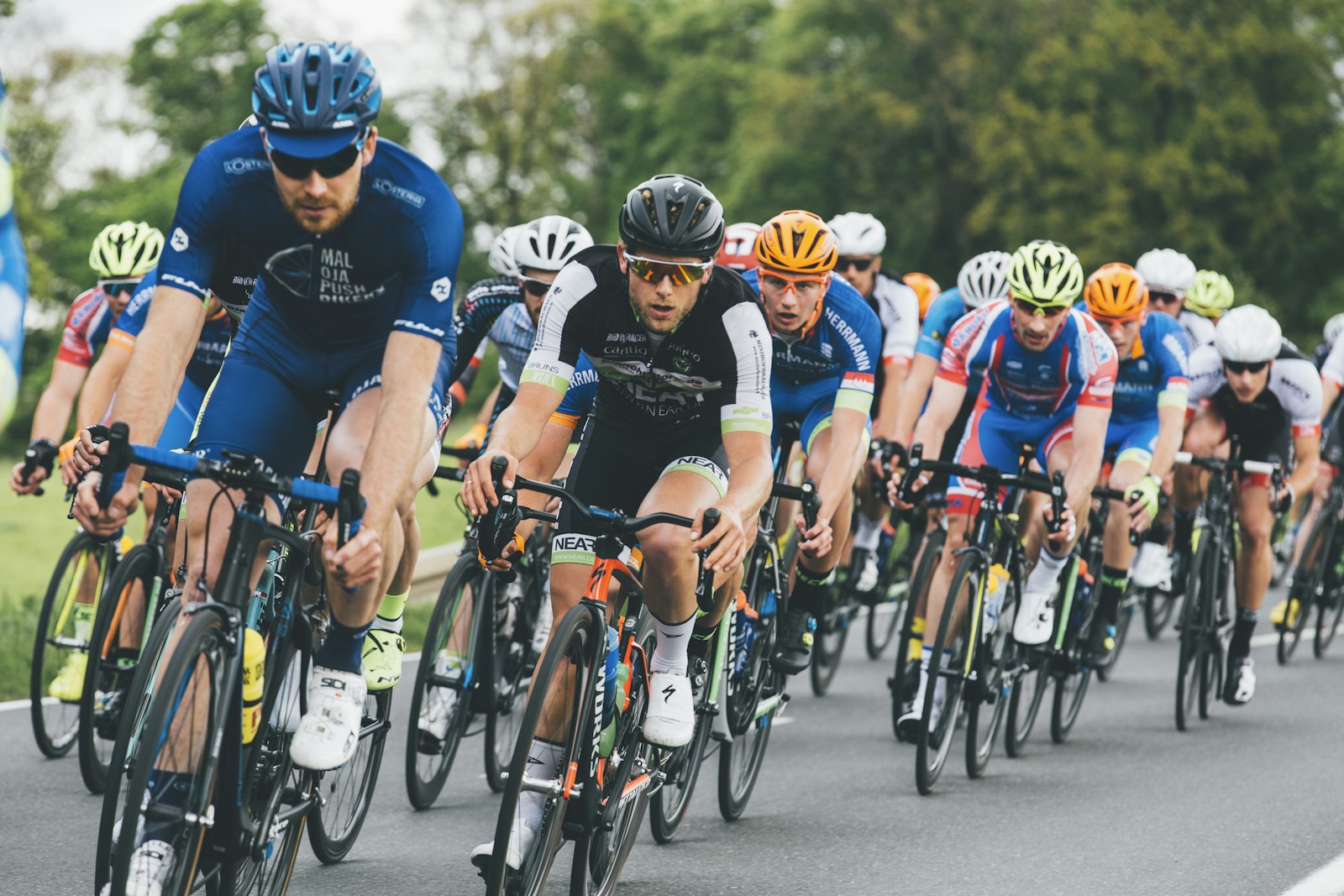
In professional cycling, races are not won by single defining moments. They are won by the relentless accumulation of tiny advantages — each one almost invisible in isolation, but devastating in combination over 3,500 kilometres and 21 stages.
When Sir Dave Brailsford took over British Cycling in 2003, he introduced a philosophy that would transform not just British cycling, but the entire sport. The concept was deceptively simple: identify every factor that influences performance, and improve each one by just 1%. Rider position. Sleep quality. Training nutrition. Tyre pressure. Even the type of pillow a rider sleeps on during a Grand Tour.
The results spoke for themselves. British Cycling went from near-irrelevance to dominance. The same framework, applied at Team Sky and later across the peloton, became the defining performance methodology of modern professional cycling. And it raised a critical question: once every team has optimised aerodynamics, nutrition, and equipment, where does the next marginal gain come from?
For Team Visma–Lease a Bike, the answer includes one of the most overlooked variables in elite performance: breathing.
The Marginal Gains Philosophy in Modern Cycling
The marginal gains framework operates on a fundamental principle: compounding. A 1% improvement in aerodynamics might save a rider 12 seconds over a flat time trial stage. A 1% improvement in nutritional strategy might translate to an extra 15 watts sustained through a final climb. A 1% improvement in sleep quality compounds across all 21 stages, affecting recovery, hormonal balance, and cognitive sharpness on race days.
None of these gains are visible in isolation. But add them together across the full race duration, and a team that has systematically optimised every variable will beat a team that hasn't — even when raw talent is equivalent. This is the lever that separates Team Visma's Jonas Vingegaard from rivals who train just as hard and rest just as carefully.
The challenge in 2026 is that the low-hanging fruit has been harvested. Every WorldTour team runs wind-tunnel-optimised equipment. Every team employs nutritionists, physiologists, and sports scientists. The competitive advantage now lies in the variables most teams haven't yet fully quantified — and breathing is chief among them.
Where Teams Are Still Leaving Time on the Table
In the grand architecture of professional cycling performance, breathing remains surprisingly underinvested. Teams spend millions on custom-painted frames, proprietary fabrics, and athlete-specific nutritional formulations. Yet the mechanics of respiration — how air enters the body, how efficiently it is processed, how much effort the respiratory system demands at threshold — receive a fraction of that attention.
This is not because breathing is unimportant. It is because, until recently, the tools to meaningfully intervene in breathing mechanics were limited. That has changed.
Why Breathing Is the Most Overlooked Performance Variable
At a cellular level, cycling performance is an oxygen delivery problem. The muscles need ATP. ATP is produced via oxidative phosphorylation. Oxidative phosphorylation requires oxygen. The chain from ambient air to mitochondrial oxygen utilisation runs through the nose, the trachea, the bronchi, the alveoli, the blood, and the working tissue — and each step has a rate-limiting constraint.
Most training and supplementation targets the downstream end of this chain: VO2 max, haematocrit, cardiac output. But the very first step — getting sufficient air through the nasal passages efficiently — is often ignored.
The nasal passages perform critical functions that mouth breathing cannot replicate:
- Filter and humidify incoming air, reducing airway inflammation over long stages
- Warm cold air before it reaches the lungs, protecting sensitive alveolar tissue
- Produce nitric oxide — a potent vasodilator that improves oxygen uptake at the pulmonary level
- Engage the diaphragm more deeply, improving respiratory efficiency and core stability
- Optimise the O2/CO2 exchange ratio, reducing hyperventilation risk under maximum effort
The problem is that at high intensities, nasal resistance becomes a bottleneck. The nasal valve — the narrowest point of the airway — restricts airflow precisely when demand is highest. Riders who try to breathe nasally under heavy exertion feel they are fighting their own anatomy. Most abandon nasal breathing and revert to mouth breathing, losing all of the physiological benefits listed above.
How HISTRIPS Delivers Measurable Gains for Pro Cyclists
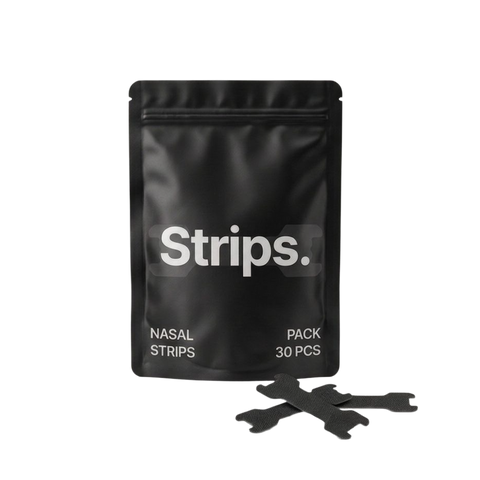
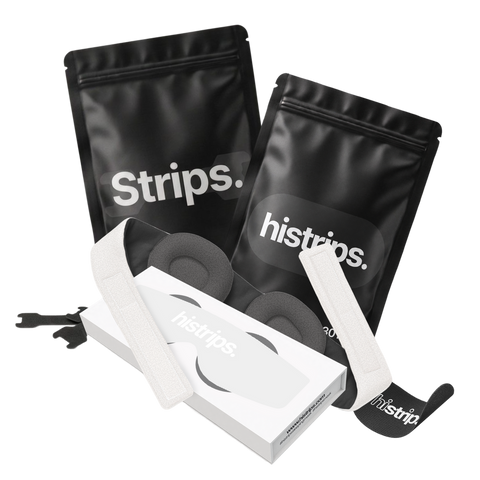
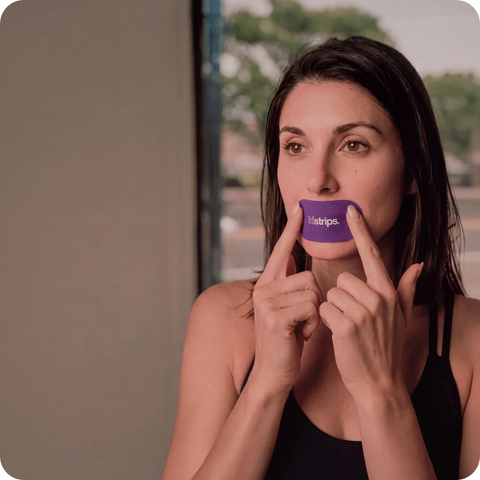
HISTRIPS nasal strips solve the nasal resistance problem mechanically, without drugs, without training load, and without conscious effort from the rider. The strip is a spring-loaded adhesive band placed across the bridge of the nose. As the band tries to return to its flat shape, it gently lifts the flexible nasal cartilage outward, widening the nasal valve and reducing resistance to airflow.
The result: nasal airflow increases by over 40%. This single intervention unlocks all of the physiological benefits of nasal breathing — at the intensities where it matters most.
- More volume delivered per breath, reducing respiratory effort at threshold
- Higher nitric oxide levels, improving pulmonary vasodilation and O2 transfer
- Reduced respiratory muscle fatigue over long stages
- Better diaphragmatic engagement and core pressure management on climbs
- Improved airway health through filtration and humidification, especially on dusty or cold stages
Across a three-week Tour de France, these gains compound in exactly the way Brailsford's marginal gains framework describes. A 2% reduction in respiratory effort per stage may not be measurable in a single day's power data. But its effect on cumulative fatigue, recovery capacity, and performance in the final week — when the race is typically decided — is substantial.
The Clinical Evidence
Independent clinical testing has confirmed that HISTRIPS increase nasal airflow by 40%+ under controlled conditions. Sports science studies on nasal dilator strips show consistent reductions in perceived exertion at equivalent power outputs, improvements in blood oxygen saturation during high-intensity efforts, and reduced respiratory muscle activation — meaning more metabolic resources directed to the legs rather than the diaphragm.
Team Visma's Performance Stack
Team Visma–Lease a Bike approaches performance with the same systematic rigour that Brailsford applied at British Cycling. Their performance stack integrates every variable that influences the outcome of a Grand Tour: altitude camp periodisation, metabolic testing, sleep monitoring, aerodynamic optimisation at the individual rider level, nutritional timing down to the gram, and recovery protocols that begin in the final kilometres of each stage.
HISTRIPS sits within this stack as a breathing optimisation layer. Riders apply strips before warm-up on race mornings and retain them through the full stage. On recovery days and during training blocks, the same protocol applies — because the benefits of nasal breathing are not limited to race performance. During overnight sleep, HISTRIPS helps maintain nasal airflow, improving sleep quality and the hormonal recovery processes that determine how riders feel at the start line the following morning.
The Visma performance philosophy asks a relentless question of every intervention: does this make the rider measurably better, and does the benefit compound across the race? For HISTRIPS, the answer is yes on both counts. Breathing optimisation is not a single gain — it is a gain that replicates itself at every effort, across every stage, in every condition the Tour presents.
In a sport where fractions of a percent decide podium finishes, that is exactly the kind of marginal gain that wins races.
Add HISTRIPS to Your Performance Stack
The same nasal strips trusted by Team Visma–Lease a Bike at the Tour de France. Every 1% counts.
Shop HISTRIPS Now


Leave a comment
This site is protected by hCaptcha and the hCaptcha Privacy Policy and Terms of Service apply.