
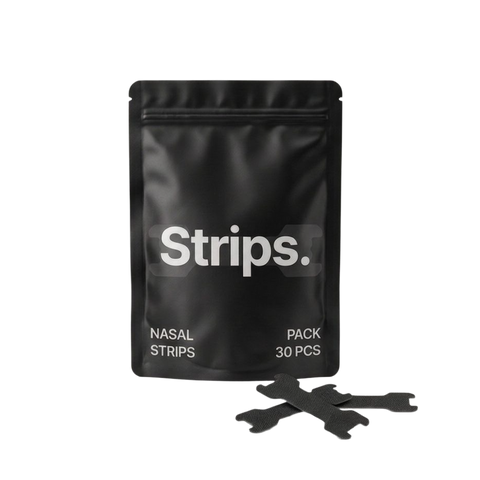
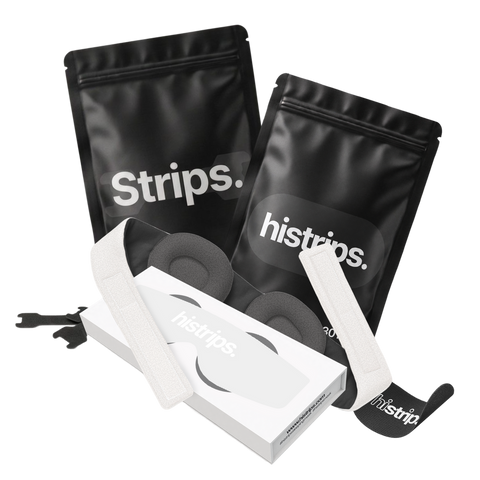





Look around any serious gym, CrossFit box, or functional training studio and you'll start noticing them: the small adhesive strips across athletes' noses during lifts, conditioning work, and HIIT sessions. Nasal strips are no longer just a running thing — they've become a fixture of gym performance culture. Here's the science behind why.
The Breathing Challenge in Weight Training
Weight training places unique demands on the respiratory system. During heavy compound lifts — squats, deadlifts, overhead press — the body needs to manage two competing priorities simultaneously: maximal oxygen intake and intra-abdominal pressure for spinal stability.
Proper breathing technique in the gym involves a Valsalva manoeuvre on heavy lifts: inhale deeply, brace the core, lift, exhale at the top or on the way down. This technique creates intra-abdominal pressure that protects the spine under load. But it requires a full, deep nasal breath — and if the nasal valve is restricted, that breath is compromised from the start.
Nasal Breathing and Intra-Abdominal Pressure
The diaphragm is the primary muscle of respiration and a key stabiliser of the core during lifting. Nasal breathing activates the diaphragm more effectively than shallow mouth breathing, contributing to stronger core engagement and better spinal support under load.
HiStrips widen the nasal valve to reduce resistance, allowing a fuller, deeper nasal breath before each heavy set. The result is better oxygen loading, stronger core activation, and more stable spinal mechanics on every rep.
Oxygen During Lifting: Why It Matters More Than You Think
The common assumption is that lifting is anaerobic — and therefore breathing doesn't matter as much. This is partially true for single maximal efforts, but for most training protocols (sets of 5–12 reps, supersets, circuit training), the aerobic energy system is significantly involved.
Between sets, the speed and quality of recovery is largely determined by how quickly your body can restore oxygen to working muscles and clear metabolic byproducts. Optimised nasal breathing during rest periods accelerates this process, allowing shorter rest times and more total volume in a session.
Nose strips like HiStrips ensure that nasal breathing remains efficient throughout the session — in rest periods as much as during working sets.
HIIT and CrossFit: Where Nasal Strips Really Shine
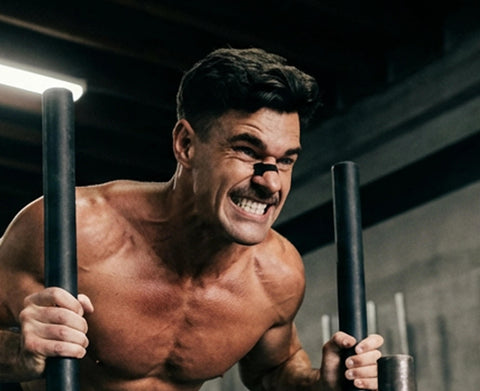
High-Intensity Interval Training and CrossFit present the most demanding respiratory challenge of any gym modality. Transitions between different movement patterns, combined with near-maximal heart rates, push athletes toward rapid, shallow mouth breathing almost inevitably.
Nasal strips don't eliminate the need for mouth breathing at genuine maximum effort — but they expand the range of intensities at which nasal breathing is sustainable, delaying the threshold at which you have to switch to mouth-only breathing. This preserves the nitric oxide advantage and the airway-filtering benefit for longer into each workout.
Many HiStrips athletes report being able to maintain nasal breathing through rounds that previously forced them to exclusively mouth breathe — a meaningful edge in conditioning performance.
How to Use HiStrips at the Gym
- Apply 5–10 minutes before your warm-up to ensure full adhesion before you begin sweating.
- Wipe your nose with a face wipe first if you've been sweating during commute or a cardio warm-up — clean skin is essential for strip adhesion.
- Position correctly over the nasal flare for maximum valve opening — not on the bony bridge.
- Don't remove mid-session — HiStrips are designed to stay on through a full training session. If the strip needs to be replaced, always prep the skin before re-application.
Frequently Asked Questions
Will nasal strips help me lift more weight?
Nasal strips improve nasal airflow and support optimal breathing mechanics during lifting. They won't directly increase your 1RM, but by optimising your breathing technique and recovery between sets, they support more consistent, higher-quality training sessions — which compounds into strength and performance gains over time.
Can nasal strips stay on during a sweaty gym session?
Yes — when applied to properly prepared skin. Clean, dry skin before application is the key. HiStrips' sweat-resistant adhesive is tested for athletic use and maintains bond through a full gym session when skin is prepared correctly.
Are nasal strips useful for cardio machines (treadmill, rowing, cycling)?
Absolutely. Any cardio modality that increases breathing demand benefits from reduced nasal resistance. Many HiStrips athletes use strips during treadmill running, cycling, and rowing as well as free weights and functional training.
Train Harder. Recover Faster.
Your gym performance starts with your breath. HiStrips are the athlete-grade nasal strip built for the demands of serious training — from warm-up through the final conditioning round.
Shop HiStrips at histrips.com and feel the difference from your very first set.


Leave a comment
This site is protected by hCaptcha and the hCaptcha Privacy Policy and Terms of Service apply.